



The Impact of Social Media on Mental Health and Self-Esteem
Social media can help people stay connected, express themselves, and find support. It can also expose users to comparison, appearance pressure, and feedback that affects mood or self-esteem. Its impact depends on what someone sees, how they use platforms, and what else is happening in their life.
How social media shapes everyday experience
Social media shapes everyday experience by making communication, self-expression, and exposure to other people’s lives part of a regular routine. These connections can bring support and belonging, though a carefully edited feed can also distort what everyday life looks like.
Platforms let people share interests, keep up with family, join communities, and find perspectives they may not encounter offline. For someone who feels isolated in their local environment, an online group can offer practical advice or the comfort of being understood. Creative posts can also help people explore identity and communicate on their own terms.
At the same time, a feed is a selection, not a full record of anyone’s life. People tend to post highlights, milestones, and polished images more often than mundane routines or difficult moments. Frequent exposure to these snapshots can make other people’s lives seem unusually successful or effortless, even when a viewer knows intellectually that posts are curated.
Connection and curation happen together. The same platform can make a person feel closer to friends in one moment and more dissatisfied in the next. Noticing that mixed experience is a useful starting point for understanding personal social media use.
Potential effects on mental health
Social media may influence mood, stress, and feelings of connection or isolation, but its effects vary and are not automatically harmful. Researchers often find associations between particular patterns of use and well-being; an association alone does not prove that one caused the other.
Active use, such as messaging a friend or contributing to a supportive group, can strengthen social connection. Passive scrolling, especially when it becomes prolonged or emotionally charged, may leave some people feeling distracted, tense, or left out. Notifications and the pressure to respond can also interrupt rest, school, or work, adding stress to an already busy day.
How someone feels before opening an app matters, too. A person who is lonely or anxious may turn to social media for relief, but a feed full of conflict or comparison could worsen their mood. The reverse can happen as well: reassuring contact or useful information may help. This two-way relationship makes simple claims about screen time misleading.
Consider the pattern, not just the minutes: What were you doing online? How did you feel before and after? Did the session support connection, or leave you more unsettled? These questions offer more useful clues than a universal time limit. The U.S. Surgeon General’s advisory on social media and youth mental health also discusses potential benefits and risks, particularly for young people.
Social comparison, body image, and self-esteem
Social comparison can affect self-esteem when people judge their own lives or appearance against idealized posts. Appearance-focused images and online feedback may intensify that pressure, although users respond differently and social media can also provide affirming representation.
People naturally compare themselves with others. On social platforms, the comparison target is often a polished image, a carefully selected achievement, or a public count of likes and comments. Comparing those visible details with one’s own unfiltered life can make ordinary setbacks feel like personal shortcomings.
Body image may be especially sensitive to repeated exposure to narrow appearance ideals, beauty filters, or content that treats a particular shape as the standard. Some users find communities that celebrate diverse bodies and identities; others encounter posts that encourage scrutiny or dissatisfaction. The content mix and the viewer’s circumstances both matter.
Online feedback can shape self-perception when likes, comments, or views start to feel like a measure of worth. A post receiving little response does not establish anything about a person’s value, but it can still sting. Self-esteem is more stable when it rests on a wider foundation than digital approval, including relationships, values, skills, and experiences offline.
Why the effects differ from person to person
Social media affects people differently because content, context, age, existing well-being, and patterns of use all shape the experience. A supportive conversation and a stream of hostile comments are both online interactions, but they are unlikely to feel the same.
Age and life stage can influence how users encounter social pressure and feedback. So can personal circumstances: someone dealing with loneliness, body-image concerns, or a stressful period may be more affected by certain posts. This does not mean they are at fault. It means the same feed can land differently depending on what a person is carrying.
The way someone uses a platform matters as much as the platform itself. Direct messaging, sharing creative work, and following educational accounts are different experiences from repeatedly checking metrics or scrolling through content that triggers comparison. Even within one app, a person’s feed can change after they mute accounts, search for new interests, or engage with different communities.
There is no single amount of social media use that suits everyone. Choosing to reduce time online may help if it is crowding out sleep or relationships, but a strict limit can feel unnecessary or impractical for someone who relies on online communities. A better measure is whether use supports daily life and aligns with personal needs.
Signs your social media habits may be affecting you
Social media habits may be affecting well-being when use repeatedly leaves you distressed or interferes with sleep, relationships, responsibilities, or activities you value. These are cues for reflection, not a diagnosis.
- You notice a persistent drop in mood, confidence, or body satisfaction after viewing certain accounts or content.
- You check notifications or engagement numbers so often that it becomes hard to focus on other tasks.
- You feel pressured to post, respond, or stay online even when you would rather take a break.
- Scrolling regularly delays sleep, replaces in-person contact, or pushes aside work, study, or hobbies.
- You feel more isolated or anxious after browsing, yet find it difficult to stop or change what you see.
One difficult session does not necessarily signal a larger problem. Look for a recurring pattern and its effect on your day. If distress is persistent, intense, or interfering with daily life, consider talking with a mental health professional or a trusted health-care provider.
Practical ways to build a healthier relationship with social media
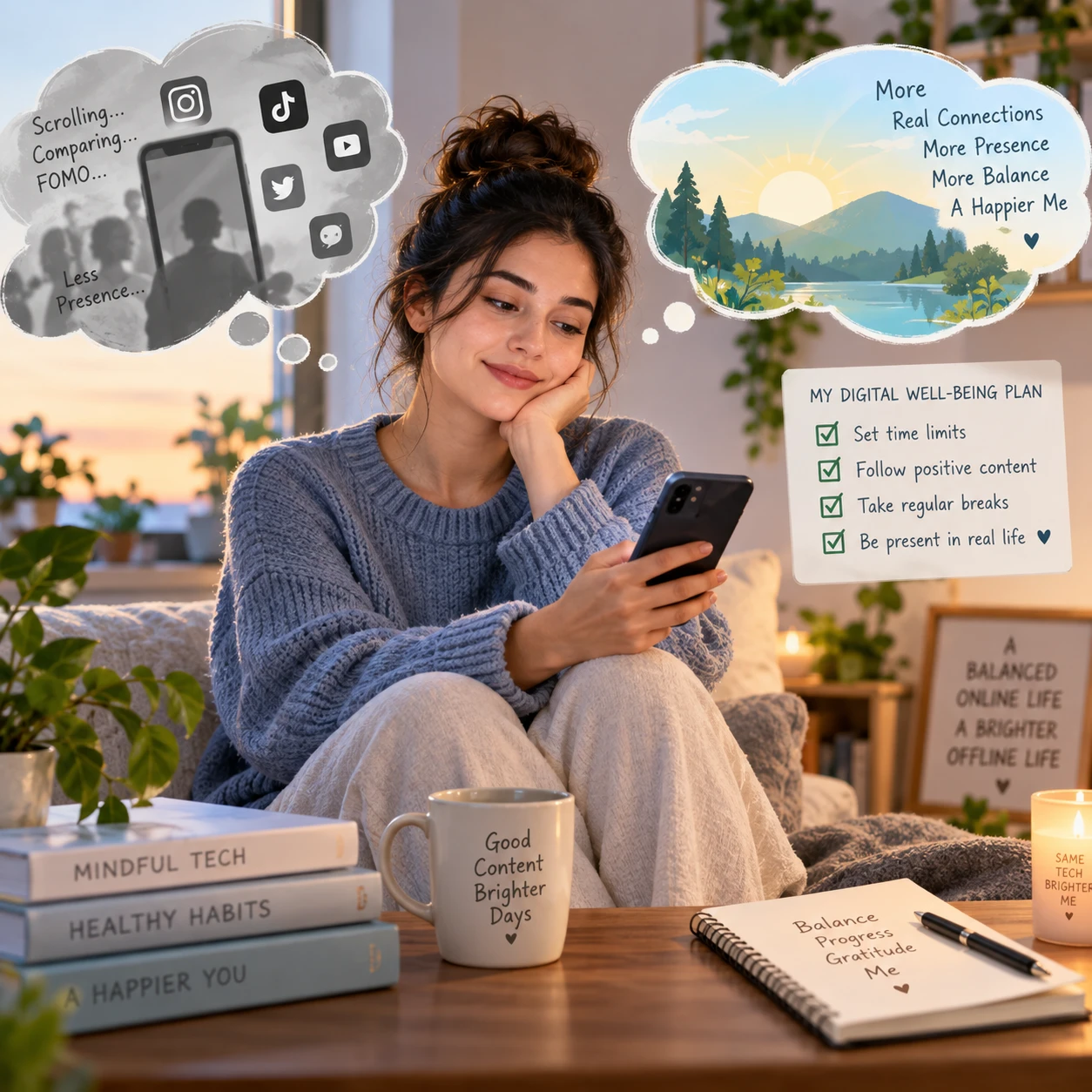
To build a healthier relationship with social media, notice how it affects you, adjust what appears in your feed, and set boundaries that fit your routines. Small, repeatable changes are often easier to maintain than an all-or-nothing digital detox.
- Review your feed. Unfollow, mute, or hide accounts that reliably leave you feeling inadequate or agitated. Add sources that support your interests, offer varied perspectives, or make you feel connected.
- Check your emotional response. After a session, take a moment to ask what you were seeking and how you feel now. A brief note in your phone or journal can reveal which content and situations affect your mood.
- Create practical boundaries. Turn off nonessential notifications, keep your phone away during meals or bedtime, or choose a few set times to check apps. Try one change for a week, then decide whether it helped.
- Choose active connection when possible. Send a message, join a thoughtful discussion, or share something meaningful instead of scrolling automatically. Active use is not always better, but it can make the purpose of being online clearer.
- Protect offline foundations. Make room for sleep, movement, face-to-face relationships, and activities that build confidence without public feedback. These routines can give self-esteem more sources of support.
Mindful boundaries should serve your life, not become another standard to fail. If a strategy makes you feel cut off from supportive people, revise it. The aim is digital well-being: using social media in ways that preserve connection while limiting patterns that consistently undermine mood or self-respect.