


Cognitive Biases in Everyday Decision Making: Why Your Brain Misleads You (and How to Think Clearer)
What Are Cognitive Biases — and Why Do We All Have Them?
Cognitive biases are systematic errors in thinking that cause people to deviate from rational judgment in predictable ways. They are not a sign of low intelligence — they are a feature of how every human brain processes information under pressure, uncertainty, or limited time.
Think of them as mental blind spots baked into the architecture of human cognition. They emerge from the same mental shortcuts that helped our ancestors make split-second survival decisions. The brain that quickly judged a rustling bush as a potential predator — rather than pausing to gather data — was the brain that survived long enough to pass on its genes.
The problem is that the modern world rarely calls for that kind of snap judgment, yet the hardware hasn't changed. We're running ancient software on 21st-century problems: negotiating salaries, choosing medical treatments, evaluating news stories, deciding who to trust.
Behavioral science has catalogued over 180 documented cognitive biases, but the goal here isn't to memorize a list. It's to understand the underlying patterns well enough to catch them when they matter.
The Brain's Shortcut System: Heuristics and Dual-Process Thinking
Heuristics are mental shortcuts the brain uses to make decisions faster and with less cognitive effort. They're not inherently bad — they're often accurate enough and save enormous mental energy. The issue arises when they're applied in contexts where they don't fit.
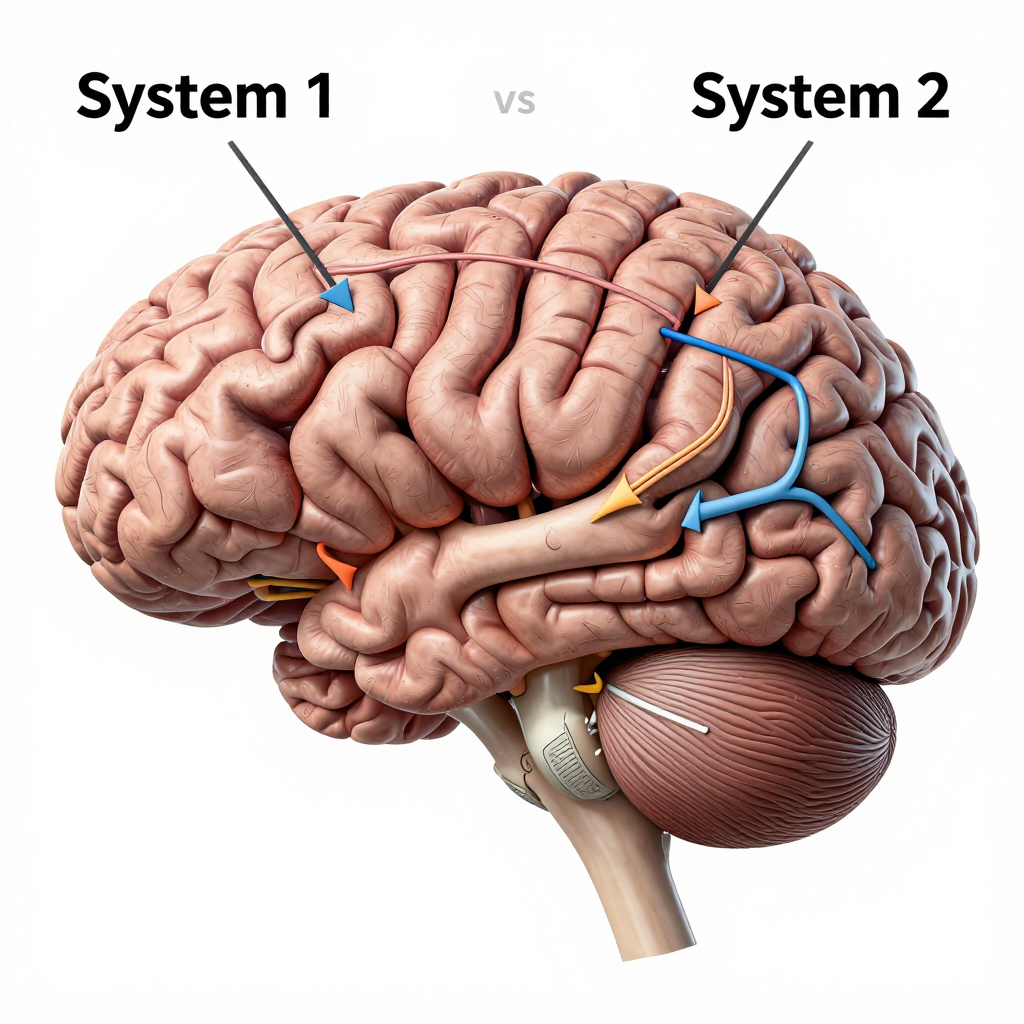
Psychologist Daniel Kahneman, in his landmark work on behavioral economics, described two modes of thinking that govern how we process information:
- System 1 — fast, automatic, intuitive, emotional. It operates below conscious awareness and handles most of our daily decisions.
- System 2 — slow, deliberate, analytical, effortful. It kicks in when we face genuinely complex problems — but only if we actively engage it.
Cognitive biases are largely a System 1 phenomenon. When you make a quick judgment about a person, a price, or a risk, System 1 is running the show. System 2 could override it — but it's lazy by design. It conserves energy by deferring to System 1 whenever possible.
This is why simply knowing about a bias doesn't automatically protect you from it. Awareness is necessary, but it's not sufficient on its own.
The Most Common Cognitive Biases You Encounter Every Day
Several cognitive biases appear so frequently in daily life that recognizing them can immediately improve your decision-making quality.
Confirmation Bias
Confirmation bias is the tendency to search for, interpret, and remember information that confirms what you already believe. If you think a colleague is incompetent, you'll unconsciously notice every mistake they make while discounting their successes. It's one of the most pervasive biases in political thinking, personal relationships, and business strategy.
The Anchoring Effect
When you're exposed to an initial piece of information — a price, a number, an estimate — it disproportionately influences every judgment that follows. A product originally priced at $500, marked down to $300, feels like a deal even if $300 is still overpriced. The anchor sets the frame; everything else becomes relative to it.
The Availability Heuristic
People judge the likelihood of events based on how easily examples come to mind. After seeing news coverage of plane crashes, many people overestimate the danger of flying while underestimating the statistical risk of driving — even though the data strongly favors air travel. Vivid, recent, or emotionally charged events feel more probable than they actually are.
Loss Aversion
Kahneman and Amos Tversky demonstrated that losses feel roughly twice as painful as equivalent gains feel pleasurable. Losing $100 hurts more than winning $100 feels good. This asymmetry leads people to make irrational choices — holding losing investments too long, avoiding necessary risks, or sticking with a bad situation simply to avoid the feeling of loss.
The Dunning-Kruger Effect
People with limited knowledge in a domain tend to overestimate their competence, while genuine experts often underestimate theirs. It's not arrogance — it's a calibration problem. You can't know what you don't know, so beginners often lack the framework to recognize the limits of their own understanding.
How Cognitive Biases Show Up in Key Life Decisions
Biases don't stay abstract — they shape the decisions that actually matter in your life.
In financial choices, loss aversion causes investors to sell winning stocks too early (to lock in gains) and hold losing ones too long (to avoid realizing a loss). The anchoring effect makes people accept a salary offer that's just slightly above an artificially low opening number.
In health decisions, the availability heuristic leads people to fear rare but dramatic conditions they've recently heard about, while ignoring chronic risks like poor sleep or sedentary behavior that quietly accumulate over years.
In relationships, confirmation bias is particularly damaging. Once you've formed a negative impression of someone, your brain becomes a selective evidence-collector — building a case rather than seeking the truth. This dynamic can quietly poison friendships, partnerships, and workplace teams.
At work, the Dunning-Kruger effect shapes how teams evaluate their own readiness, how managers assess employee performance, and how organizations misjudge competitive threats. Overconfidence in early-stage projects is one of the most reliable predictors of project failure.
The Hidden Cost of Unchecked Biases
The real danger of cognitive biases isn't any single bad decision — it's the cumulative drift they create over time. Each individual shortcut seems harmless. Together, they can steer a life, a career, or a relationship significantly off course.
Unchecked confirmation bias leads to increasingly narrow information diets. You stop encountering ideas that challenge your worldview, which makes you more confident and less accurate simultaneously. The Dunning-Kruger effect compounds this: as your certainty grows, your curiosity shrinks.
Loss aversion keeps people trapped in jobs they've outgrown, relationships that no longer serve them, and strategies that stopped working years ago. The sunk cost fallacy — a close relative — convinces people to keep investing in failing endeavors simply because they've already invested so much.
There's also a social dimension. Biased thinking affects how we perceive others, which shapes how we treat them, which shapes how they respond to us. The feedback loop between perception and behavior is one of the less-discussed but most consequential ways bias compounds over time.
Practical Debiasing Strategies to Make Better Decisions
Reducing the influence of cognitive biases is possible, but it requires deliberate practice rather than passive awareness. Here are strategies grounded in behavioral psychology research:
- Slow down before high-stakes decisions. System 1 thrives on speed. Introducing a pause — even 10 minutes — activates System 2 and creates space for more deliberate analysis. Ask yourself: "What would I think about this if I had no emotional stake in the outcome?"
- Actively seek disconfirming evidence. For any belief you hold strongly, spend five minutes genuinely looking for evidence against it. This is uncomfortable by design — confirmation bias makes it feel wrong. That discomfort is a signal you're doing it correctly.
- Run a pre-mortem. Before committing to a major decision, imagine it's one year in the future and the plan has failed spectacularly. What went wrong? This technique, developed by psychologist Gary Klein, surfaces blind spots that optimism bias would otherwise hide.
- Diversify your input sources. Surround yourself with people who think differently, have different expertise, and are willing to disagree with you. Cognitive diversity in a group consistently outperforms individual brilliance on complex problems.
- Name the bias in the moment. When you notice a strong emotional pull toward a decision, pause and ask which bias might be operating. Simply labeling it — "this feels like loss aversion" — creates enough psychological distance to reconsider.
No strategy eliminates bias entirely. The goal is reduction, not perfection. Even Kahneman, who spent decades studying these patterns, acknowledged that knowing about biases doesn't make you immune to them. What changes is your ability to catch them before they do damage.
Building a More Reflective Mind Over Time
Awareness of cognitive biases is the starting point, not the destination. The real work is building habits of reflection that become second nature over months and years.
Keeping a decision journal is one of the most underrated practices in behavioral self-improvement. Write down significant decisions, the reasoning behind them, and your expected outcomes. Revisit them later. The gap between what you predicted and what happened is where the most honest learning lives.
Intellectual humility — genuinely valuing the possibility that you're wrong — is the foundational attitude that makes debiasing possible. It's not a weakness. It's the cognitive posture that separates people who keep improving from those who plateau.
The field of behavioral economics has shown repeatedly that environments can be designed to nudge better decisions — but you can also design your own mental environment. What information do you consume? Who challenges you? What decision-making processes do you follow by default?
Clearer thinking isn't about becoming a logic machine. It's about becoming a more honest observer of your own mind — curious about where it leads you astray, and committed to doing something about it.
Frequently Asked Questions
Can cognitive biases ever be useful or helpful?
Yes. Many heuristics that produce biases are genuinely useful in low-stakes or time-pressured situations. The availability heuristic helps you quickly assess everyday risks. Loss aversion protects you from reckless gambles. The problem arises when these shortcuts are applied in high-stakes, complex contexts where careful analysis would serve you better.
What is the difference between a cognitive bias and a logical fallacy?
A cognitive bias is a systematic pattern in how the brain processes information — it operates largely unconsciously. A logical fallacy is an error in the structure of an argument — it's a reasoning mistake that can be identified and labeled in explicit discourse. Biases often produce fallacies, but the two aren't the same thing.
Are some people more prone to cognitive biases than others?
Research suggests that susceptibility varies based on factors like cognitive style, need for cognition, and domain expertise. However, no one is immune. High intelligence doesn't protect against bias — in some cases, it just makes people better at rationalizing biased conclusions after the fact.
How does stress or emotion increase susceptibility to biased thinking?
Stress and strong emotion deplete the cognitive resources needed for System 2 thinking. When you're under pressure, tired, or emotionally activated, the brain defaults more heavily to fast, automatic System 1 processing — which is where most biases operate. This is why major decisions made in moments of anger, fear, or exhaustion tend to be lower quality.
What is the best first step to start recognizing my own biases?
Pick one bias — confirmation bias is a good starting point because it's so pervasive — and spend one week actively looking for it in your own thinking. Notice when you're seeking information that agrees with you versus information that challenges you. That single focused practice builds more self-awareness than reading about twenty biases at once.